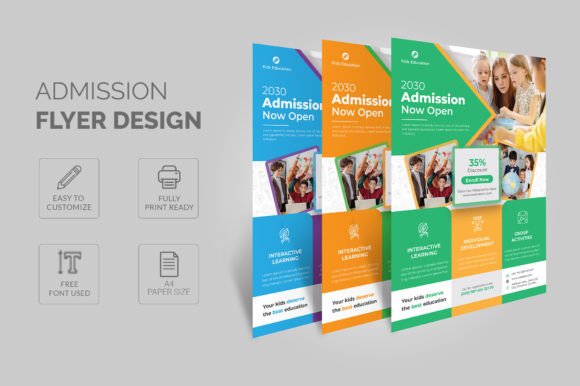
Mastering the School Admission Flyer: A Strategic Asset for Educational Growth
In the competitive landscape of modern education, the first point of contact between an institution and a prospective family is often visual. It is not merely a digital banner or a social media post; it is frequently a tangible piece of communication that conveys trust, quality, and opportunity. This is where the School Admission Flyer becomes an indispensable tool. Far beyond a simple announcement, a well-crafted flyer serves as a bridge connecting educational aspirations with institutional reality. For professionals, creators, and marketers in the education sector, understanding the power of this medium is essential for driving enrollment and building brand authority.
The Evolution of Educational Marketing Materials
The role of printed marketing materials has shifted dramatically over the last decade. In an era dominated by fleeting digital notifications, physical media carries a unique weight. Parents and guardians are inundated with emails and ads, yet a high-quality School Admission Flyer handed to them at a community event or placed on a kitchen table demands attention in a way that pixels often cannot. This resurgence in print relevance is driven by a consumer trend toward tangible proof of quality. When a parent holds a flyer that feels substantial and looks professional, they subconsciously attribute those qualities to the school itself.
This shift reflects a broader change in how educational institutions approach their branding. The market is no longer just about listing curriculum details; it is about creating an emotional connection. A clean, eye-catching design signals that the school values aesthetics and attention to detail—traits that parents hope will be mirrored in their children's learning environment. Consequently, the School Admission Flyer has evolved from a basic informational sheet into a sophisticated piece of corporate identity.
Why Design Matters in the Education Sector
The effectiveness of any marketing collateral hinges on its ability to communicate quickly and clearly. In the context of school admissions, the stakes are high. Families are making life-altering decisions based on limited information. A flyer must therefore balance creativity with clarity. This is why the specific design attributes of a professional template are so critical. Features such as a Clean eye-catchy Kids Education Flyer layout ensure that the message is not lost in clutter. The use of vibrant yet professional colors, combined with ample white space, guides the reader's eye to the most important information: dates, requirements, and unique selling points.
Furthermore, the design must resonate with the target demographic. While the primary audience is parents, the secondary audience is the students themselves. A design that appeals only to adults may fail to capture the imagination of the child, who often influences the final decision. Therefore, the best School Admission Flyer designs incorporate elements that feel welcoming and fun without sacrificing professionalism. This dual appeal is a hallmark of successful educational marketing strategies today.
Bridging Creativity and Technical Precision
For entrepreneurs and freelancers managing multiple clients, the efficiency of the design workflow is paramount. The modern marketer does not have the luxury of spending days designing a single flyer from scratch. Instead, they rely on robust, pre-engineered solutions that allow for rapid customization. This is where the concept of an Easy Customizable and Editable Corporate flyer Design becomes a game-changer. These templates are built to streamline the creative process, allowing users to focus on content strategy rather than technical hurdles.
The accessibility of these tools is a significant trend in the creative industry. You do not need to be a master graphic designer to produce world-class results. With the right resources, all you need to know is the very basics of Photoshop to change the text, swap images, and adjust layouts. This democratization of design empowers small private schools, tutoring centers, and language academies to compete visually with large educational conglomerates. It levels the playing field, ensuring that budget constraints do not equate to poor presentation.
Technical Standards for Professional Output
While ease of editing is crucial, the final output must meet rigorous industry standards. A flyer that looks good on a screen but fails when printed is a wasted investment. Professional templates address this by adhering to strict specifications. For instance, a CMYK Color Design ensures that the colors printed match the intended vibrancy, avoiding the dullness often associated with RGB-to-CMYK conversions done incorrectly. Additionally, a resolution of 300 DPI guarantees sharp text and crisp imagery, which is vital for maintaining credibility.
Another critical aspect is the formatting for print production. A standard A4 Paper Size With Bleeds ensures that the design extends beyond the trim edge, preventing unsightly white borders after cutting. This "print ready" status eliminates the guesswork for printers and reduces the risk of costly errors. For the busy marketer, knowing that a file is ready to go straight to the press saves time and reduces stress, allowing for a faster turnaround from concept to distribution.
Adapting to Changing Workflows and Expectations
The needs of educational businesses are constantly evolving. Institutions now require marketing assets that are versatile enough to serve multiple purposes. A single School Admission Flyer might be used for a physical open house, distributed via mailers, or even scanned for digital distribution. To accommodate this flexibility, modern templates come with comprehensive file packages. Typically, these include 3 AI File versions for Adobe Illustrator, 3 EPS File options for compatibility with various software, and supporting documentation like an Information File and a Read Me File.
This multi-format approach reflects a forward-looking strategy in business operations. It acknowledges that workflows vary across different teams and agencies. Some designers prefer vector-based editing in Illustrator, while others might work within different environments. By providing multiple file types, the template ensures that the asset remains usable regardless of the software stack. This adaptability is a key factor in why professionals are increasingly paying attention to high-quality, modular design resources.
The Role of Typography in Brand Perception
Typography plays a subtle but powerful role in how a message is received. In the realm of education, fonts must strike a balance between readability and personality. The Font Used Montserrat in many top-tier templates is a prime example of this balance. Montserrat is a geometric sans-serif typeface known for its clarity and modern aesthetic. It is highly legible at various sizes, making it perfect for headlines, body text, and call-to-action buttons alike.
Choosing the right font is not just a stylistic choice; it is a psychological one. Montserrat conveys a sense of stability, innovation, and approachability—qualities that align perfectly with the goals of a progressive educational institution. When parents read a flyer set in Montserrat, they perceive the institution as organized and contemporary. This attention to typographic detail contributes to the overall narrative of excellence that the School Admission Flyer aims to project.
Strategic Implementation for Maximum Impact
To truly leverage the power of a School Admission Flyer, institutions must integrate it into a broader marketing ecosystem. It should not exist in isolation. Instead, it should complement digital campaigns, social media efforts, and direct outreach programs. For example, a flyer distributed at a local fair can include a QR code that directs parents to a virtual tour of the campus, blending the tactile experience of print with the interactivity of digital media.
Furthermore, the content of the flyer must be tailored to the specific pain points and desires of the target audience. Does the school offer specialized STEM programs? Is there a strong emphasis on arts and culture? The design should highlight these features prominently. By using the editable nature of the template, marketers can create variations of the flyer for different segments, ensuring that each message resonates deeply with its intended recipient.
Future-Proofing Your Educational Brand
As we look toward the future, the importance of high-quality visual communication will only increase. As competition intensifies, the margin for error shrinks. Schools that invest in professional, print-ready, and easily customizable marketing materials position themselves as leaders in their field. They demonstrate a commitment to excellence that extends beyond the classroom walls.
The School Admission Flyer is more than just a piece of paper; it is a strategic asset that drives growth, builds trust, and fosters community engagement. By embracing modern design principles, leveraging efficient workflows, and maintaining technical precision, educational businesses can create impactful campaigns that stand the test of time. Whether you are a seasoned marketer or a new entrepreneur entering the education space, the right flyer design is your first step toward success.
In conclusion, the intersection of creative design and practical utility defines the next generation of educational marketing. By utilizing resources that are both clean eye-catchy and technically robust, institutions can effectively communicate their value proposition to the families they serve. The result is a stronger brand, higher enrollment rates, and a more vibrant educational community.