Understanding the Value of Education Illustration in Modern Learning Design
In the rapidly evolving landscape of digital content creation, visual communication has become a cornerstone of effective teaching and learning strategies. Among the various tools available to educators, instructional designers, and marketing professionals, Education Illustration stands out as a versatile and impactful resource. Unlike generic stock photography or complex custom animations, education-focused vector illustrations offer a unique blend of clarity, flexibility, and aesthetic appeal. This article explores what makes these assets distinct, how they compare to alternative visual formats, and why they might be the optimal choice for your next project.
Defining Education Illustration and Its Core Characteristics
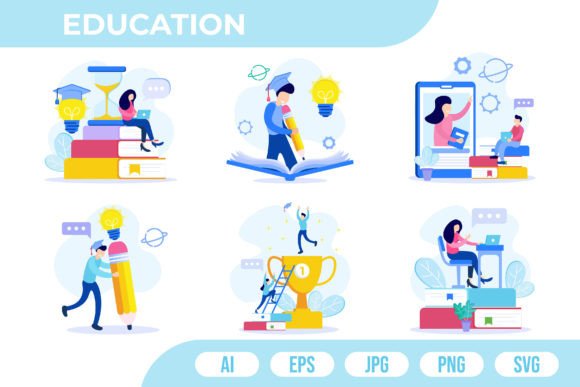
At its core, an Education Illustration is a visual representation designed specifically to support pedagogical goals. These are not merely decorative images; they are functional tools that simplify complex concepts, engage learners, and create a welcoming academic atmosphere. A typical high-quality set includes people characters engaged in various school, learning, and teaching activities. For instance, a comprehensive vector set might feature six different characters, each depicting a unique aspect of the educational journey, from solitary study to collaborative group work.
The technical foundation of these illustrations is crucial to their utility. Most professional education illustrations are delivered as vector files, such as EPS and SVG formats. This means that every line, shape, and color is defined by mathematical equations rather than pixels. Consequently, these images can be scaled infinitely without losing quality. Whether you need a tiny icon for a mobile app or a massive banner for a lecture hall, the illustration remains crisp and clear. Furthermore, well-organized shapes and editable colors in RGB mode allow designers to customize the visuals to match specific brand guidelines or thematic requirements seamlessly.
Comparing Vector Illustrations with Photographic Alternatives
When deciding on visual assets, creators often weigh the benefits of illustration against traditional photography. While photographs provide realism, they come with inherent limitations that Education Illustration effectively addresses. Photography requires coordination of models, locations, lighting, and post-production editing. It can also inadvertently introduce biases or distractions through background details, clothing brands, or specific demographic representations that may not align with a global audience.
In contrast, vector illustrations offer a level of abstraction that promotes inclusivity and focus. By using stylized characters, designers can remove unnecessary visual noise, directing the viewer’s attention strictly to the action or concept being taught. For example, an illustration of a teacher explaining a concept can be designed to be ethnically neutral or easily adjustable, ensuring that learners from diverse backgrounds feel represented. Additionally, illustrations can depict abstract ideas—such as "critical thinking" or "digital literacy"—in ways that photography simply cannot. You cannot photograph an idea, but you can illustrate it metaphorically through character expressions and symbolic elements.
The Practical Advantages of Editable Vector Formats
One of the most significant advantages of choosing a vector-based education illustration set is the degree of control it offers. When you purchase a package that includes AI, EPS, JPG, PNG, and SVG formats, you are investing in long-term usability. The ability to edit objects and colors in software like Adobe Illustrator is a game-changer for consistency. Imagine you have a corporate training module with a specific blue and gray color palette. With a raster image (like a standard JPEG), changing the color of a character’s shirt would require complex photo editing skills and could result in quality loss. With a vector file, it is a matter of selecting the shape and clicking a new color swatch.
This flexibility extends to composition as well. Well-organized shapes mean that individual elements—such as a book, a laptop, or a graduation cap—can be moved, resized, or removed entirely. This modularity allows creators to build custom scenes from a single asset pack. Instead of buying ten different images for ten different scenarios, you can adapt one versatile character set to fit multiple contexts. This not only saves money but also ensures visual coherence across all your materials, which is essential for building a strong educational brand identity.
Evaluating Use Cases: When to Choose Illustration Over Other Media
While education illustrations are powerful, they are not a one-size-fits-all solution. Understanding when to deploy them versus other media types is key to maximizing their impact. Illustrations are particularly effective in early childhood education, where bright colors and friendly characters help reduce anxiety and increase engagement. They are also ideal for e-learning modules and online courses, where file size matters. Vector-derived PNGs or SVGs are often lighter than high-resolution photographs, leading to faster load times and a smoother user experience on mobile devices.
However, there are scenarios where photography or video might be preferable. If the learning objective involves detailed procedural tasks, such as surgical techniques or mechanical repairs, realistic imagery or live-action video may be necessary to convey precise spatial relationships and textures. Similarly, for higher education levels dealing with sensitive real-world case studies, authentic photography might lend the required gravity and authenticity. The decision should always hinge on the learning outcome: does the visual aid clarify the concept, or does it distract from it?
Key Decision Factors for Selecting Quality Assets
Not all education illustration sets are created equal. When evaluating potential resources, consider the following criteria to ensure you are making a sound investment:
- Versatility of Characters: Look for sets that include a variety of poses and activities. A set of six different characters should cover a range of interactions, such as listening, presenting, writing, and collaborating. This diversity prevents visual repetition in longer presentations.
- Technical Organization: Check if the layers are logically named and grouped in the AI or EPS files. Poorly organized files can turn a simple color change into a hours-long frustration. Well-organized shapes indicate a professional workflow and save valuable design time.
- Style Consistency: Ensure the artistic style matches your target audience. A playful, cartoonish style may work for primary schools but might appear unprofessional for corporate leadership training. Conversely, a minimalist, flat design might suit tech-focused courses but feel cold for humanities subjects.
- Format Availability: Confirm that the package includes both vector (AI, EPS, SVG) and raster (JPG, PNG) formats. Having PNGs with transparent backgrounds ready for immediate use can speed up quick projects, while vectors allow for deep customization later.
Balancing Cost, Time, and Quality
From a resource management perspective, using pre-made education illustration sets offers a compelling middle ground between hiring a custom illustrator and using free, low-quality clip art. Custom illustration provides uniqueness but comes with high costs and long turnaround times. Free clip art is inexpensive but often lacks cohesion, professional polish, and legal clarity regarding usage rights.
Premium vector sets strike a balance. They provide high-quality, professionally designed assets at a fraction of the cost of custom work. Because they are editable, they offer a degree of customization that approaches bespoke design without the associated price tag. For small businesses, independent educators, and startups, this efficiency is invaluable. It allows teams to produce polished, professional-looking materials quickly, enabling them to focus more on content quality and less on graphic design hurdles.
Final Thoughts on Integrating Visuals into Education
Incorporating Education Illustration into your teaching or training materials is more than an aesthetic choice; it is a strategic decision that influences how information is perceived and retained. By leveraging the scalability, editability, and conceptual clarity of vector graphics, you can create learning environments that are both engaging and accessible. Whether you are designing a slide deck, an online course, or printed handouts, the right visual assets can bridge the gap between complex information and learner understanding.
As you evaluate your options, remember that the best tool is the one that serves your specific educational goals. Consider the nature of your content, the needs of your audience, and the technical constraints of your platform. By choosing well-organized, versatile vector illustrations, you equip yourself with a flexible resource that can grow and adapt alongside your educational initiatives. In a world where attention is scarce, clear, compelling visuals are not just nice to have—they are essential for effective communication.